|

i-SENS posts earnings surprise as CGM drives profit growth
According to KG Zeroin MP Doctor, formerly MarketPoint, i-SENS closed up 9.17% at 17,500 won, after rising as much as 20.48% intraday to 19,410 won following the release of stronger-than-expected quarterly results.
The company posted consolidated second quarter revenue of 88.5 billion won ($63.7 million), up 15.2% from a year earlier and a record for any quarter. Operating profit surged 274.1% to 6.3 billion won, while net profit climbed 341.9% to 3.5 billion won.
The results significantly exceeded market expectations. Revenue came in about 8% above the consensus estimate of 81.6 billion won, while operating profit topped the forecast of 900 million won by more than sevenfold.
The company's continuous glucose monitoring, or CGM, business was the primary growth driver.
Second quarter CGM revenue reached 9.4 billion won, up 162.4% from a year earlier and 12.7% from the previous quarter. Domestic sales totaled 3.6 billion won, while overseas sales reached 5.8 billion won, reflecting stronger international demand. First half CGM revenue totaled 17.8 billion won.
Given that revenue recognition from several customers was pushed into the third quarter, analysts said the company's full-year CGM sales target of 40 billion won appears increasingly achievable.
Beyond driving revenue growth, CGM also improved profitability.
Gross margin rose to 43.4% in the second quarter from 41.0% a year earlier as higher CGM shipment volumes created economies of scale and manufacturing improvements reduced production costs. CGM gross margin climbed into the mid-40% range, exceeding the company's overall average. Margins from its traditional blood glucose monitoring and point-of-care testing businesses also outperformed expectations.
The company cautioned, however, that higher clinical trial spending in the second half could limit further earnings expansion.
Having spent only 30% to 40% of its annual clinical budget during the first half, i-SENS expects research and development expenses to rise later this year. While blood glucose monitoring and point-of-care testing sales are expected to remain stable and CGM sales continue to grow, operating margin is likely to remain broadly in line with the first half, management said.
"Our annual CGM sales target of 40 billion won is well within reach, and we may even slightly exceed it," Chief Financial Officer Yoon Jong-woo said. "Higher CGM sales and manufacturing improvements helped us achieve a stronger-than-expected gross margin during the first half."
|
Peptron extends rebound as factory expansion revives Lilly hopes
Peptron climbed 13.77% to close at 128,900 won, extending gains for a second consecutive trading session after rebounding on July 24. Its market capitalization recovered to about 3.01 trillion won.
The stock had plunged earlier this month after CEO Choi Ho-il suggested at the Shinhan Bio Forum in Daejeon 2026 that the company's collaboration with Eli Lilly was not focused on tirzepatide, Lilly's diabetes and obesity therapy. The remarks sharply reduced investor expectations, triggering back-to-back sessions at the daily downside limit.
Many investors viewed the recent rally as a technical rebound fueled by bargain hunting following the sharp decline.
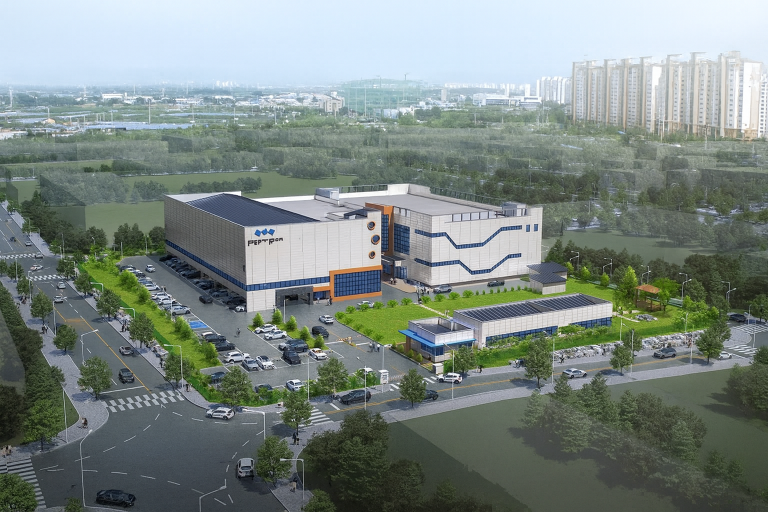
Others, however, said Peptron's plan to significantly expand its second manufacturing facility in Osong, North Chungcheong Province, revived speculation that a deal with Lilly could still materialize.
On July 24, the company announced it had applied to revise construction permits to increase the total floor area of the plant to approximately 30,000 square meters from about 12,000 square meters.
The decision to substantially expand production and support facilities prompted speculation that Peptron was preparing for commercial manufacturing of its long-acting injectable platform.
Expanded manufacturing capacity could strengthen negotiations with global pharmaceutical companies.
Even after signing a license-out agreement, companies lacking commercial-scale production capacity often need separate technology transfers and contract manufacturing partners. Owning commercial manufacturing facilities can demonstrate large-scale production capability and process reproducibility, enhancing confidence in the platform and improving negotiating leverage.
Still, an expanded factory does not necessarily signal an imminent agreement with Lilly.
Industry observers noted that several biotech companies have invested aggressively in manufacturing and research facilities based on anticipated demand, only to face delayed commercialization, low facility utilization and growing depreciation and financing costs.
GenenBio is often cited as a cautionary example. The company invested roughly 50 billion won to build the GenenCore Center, a nonclinical primate testing facility, but failed to generate the expected business results. Mounting debt eventually pushed the facility into court auction, and the company was later delisted.
Curatis faced similar challenges. The company built its Osong bioplant in advance to support commercialization of its tuberculosis vaccine and contract development and manufacturing organization, or CDMO, business. However, commercialization lagged behind capital spending, resulting in repeated fundraising efforts before management control was ultimately transferred to Inventage Lab.
Whether Peptron's second factory proves to be a successful strategic investment will ultimately depend on securing commercial contracts and production volumes.
PharmEdaily asked Peptron about the purpose of the expansion and the specific production facilities planned for the site, but the company declined to comment.
Cellid hits daily limit after U.S. patent decision
Cellid surged 29.94% to 1,367 won, hitting the daily upper trading limit after announcing that U.S. authorities had decided to grant a patent covering natural killer, or NK, cell technology used in its cancer immunotherapy vaccine.
The company's market capitalization rose to 40.3 billion won at the close.
The patent covers vaccine technology using NK cells loaded with natural killer T-cell ligands and tumor antigens.
The technology has already been patented in South Korea and Russia, while Vietnam has also approved its registration.
Cellid said it plans to pursue license-out opportunities and joint clinical development for its CelliVax platform and BVAC pipeline based on the U.S. patent.
The sharp rally also lifted the company out of immediate danger of becoming a penny stock.
Cellid had fallen as low as 973 won during trading on July 21.
Under Korea Exchange rules introduced this month, companies whose shares remain below 1,000 won or whose market capitalization stays below 20 billion won for more than 30 trading days may be designated as watchlist companies.
Even so, analysts cautioned that the patent alone may not provide a sustained catalyst for the stock.
Investor confidence was severely damaged after the company disclosed late last month that its Phase 3 clinical trial for a COVID-19 vaccine failed to meet approval criteria.
Cellid plans to continue development by changing the control vaccine and incorporating an interim analysis rather than discontinuing the program.
"The U.S. patent decision establishes long-term protection for the core technology behind the CelliVax platform," CEO Kang Chang-yul said. "Based on this intellectual property, we will actively pursue license-out opportunities and joint clinical development for the BVAC pipeline."