


“Sustainability Should be Ensured through Data-Driven Fiscal and Monetary Policy” [ESF2026]
[Sub-Title]
Day 2 of the 17th Edaily Strategy Forum
Chong-Bum An, President, The Policy Evaluation Research Institute (PERI)
“Fiscal and Financial Policy May Become Sources of Risk Rather Than Solutions”
[Edaily By Reporter Ha-yeon Shin] Chong-Bum An, President, The Policy Evaluation Research Institute (PERI), emphasized that “tax, fiscal, monetary, and financial policies must be designed based on the basis of data and empirical evidence.” while fiscal and monetary policies are key tools for responding to crises, they can also become policy risks that exacerbate crises depending on how they are managed.
President Ahn made these remarks during his opening speech at the Edaily-PERI Special Symposium held on June 17 at the Shilla Hotel in Jung-gu, Seoul, as part of the 17th Edaily Strategy Forum.
|
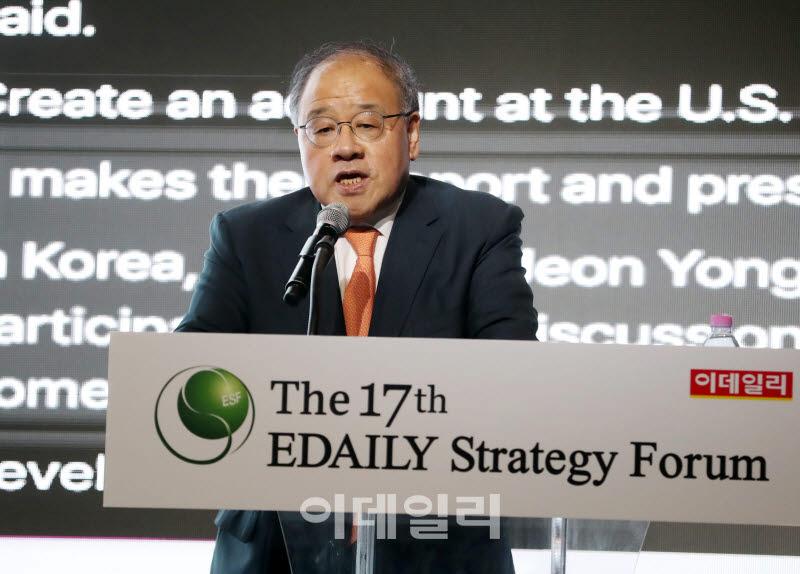
He said this year‘s symposium addresses an urgent topic amid rapidly changing global conditions. “The most important policy tools in economic security, and what can be called the core of it, are fiscal policy and financial policy,” he said. “These two policies are key tools for managing and responding to crises, but now they are in a risky situation where they could instead provoke crises.”
He repeatedly emphasized the importance of evidence-based policy evaluation. “The U.S. has enacted the Evidence-Based Policymaking Act and continues to implement it,” he said. “The core principle is that all policies must always be supported by data.”
In contrast, “In Korea, policies are created and legislated overnight in the political sphere, followed by new policies without any ex-post evaluation.” he criticized Korea’s approach, using population policy as an example, “Over the past two years, while Edaily and the population forum have been held, numerous overseas scholars have examined Korea‘s population policies, but many concluded that it is difficult to even evaluate their effectiveness.”
Ahn said, “Evidence-based policy requires data, the creation of indices, and extensive use of statistics,” adding that “PERI is working to conduct research based on handling vast amounts of data and statistics and developing indices.
He also cited diversification of national debt indicators as an example. ”There was a time when politicians, the media, and academics all used different definitions of national debt,“ Ahn recalled. ”To reduce confusion, we proposed classifying fiscal statistics into multiple categories, D1, D2, D3, and D4, depending on their scope. Through index development, evidence-based policy can become much more accessible to the public.“
He introduced intergenerational accounting, developed by Professor Alan Auerbach of UC Berkeley, and PERI’s own ‘Nara Salim Game,’ so called ‘Nation’s Household Game.‘ ”Intergenerational accounting shows how national policies create advantages or disadvantages across generations,“ he explained. ”Our institute has also been developing and using this tool since last year.“
The Nara Salim Game allows users to set national goals, select spending programs and financing methods, and see projected future outcomes based on those policy choices. ”We saw the ’Fiscal Ship Game‘ created by the Brookings Institution in 2018 and decided to develop a Korean version with their cooperation,“ he said. ”We added features that express intergenerational advantages and disadvantages in a way that makes young and older generations laugh and cry.“
He also introduced PERI’s AI-based policy consulting platform. ”We built a system that collects policy information from all public institutions for searchable access, and later launched an automated reporting system for companies through AI,“ he said.
”If you input a policy issue or risk you are facing, the AI generates a report within five minutes,“ he explained. ”If this service spreads widely, it could become a much more affordable way to meet wide range of policy needs.“
He added, ”Unlike ChatGPT, Gemini, or Claude, our system uploads all secured public data to a large language model (LLM) and generates answers only within that environment,“ and said, ”As a result, hallucinations are virtually eliminated, and the system provides consulting based on verified facts rather than generated assumptions.“
The Special Symposium on this day covered two main themes: ”Taxation · Fiscal Policy : Sustainable Taxation and Fiscal Policy in an Era of Uncertainty“ and ”Monetary · Financial Policy : Monetary and Financial Strategies for Sustainable Growth in an Age of Disorder.“ Taxation · Fiscal Policy session will feature presentations by UC Berkeley Professor Alan Auerbach and Young Lee, President of The Korea Institute of Public Finance (KIPF). Il-ho Yoo, Former Deputy Prime Minister for Economy, moderated the discussion, joined by Rep. In-cheul Cho Member of the National Assembly and Young-Jun Chun Former President, The Korean Association of Public Finance (KAPF) and Professor of Department of Economics and Finance, Hanyang University.
Monetary · Financial Policy session will feature presentations by Dartmouth College Professor Andrew Levin and Jin-il Kim Member of the Monetary Policy Board, Bank of Korea. Former Member of the Monetary Policy Board, Bank of Korea, Yoon-jae Cho, now Distinguished Professor, Graduate School of Economics, Yonsei University, will moderate, with Soo-Min Park Member of the National Assembly (People Power Party of Korea), Dong-hyun Ahn Professor Economics at Seoul National University, and Cynyoung Park Director, The South East Asian Central Banks(SEACEN), participating in the discussion.