





|

Curiox hits daily ceiling on $370,000 global pharma order
According to KG Zeroin’s MP DOCTOR, Curiox Biosystems closed at 50,600 won, up 11,650 won, or 29.91%, from the previous session. The stock quickly reached the daily upper limit in early trading after the company disclosed an order worth 510 million won ($370,000) from a global pharmaceutical company.
In its August investor relations letter, Curiox said it had “recently secured an order worth 510 million won from one of the world’s leading pharmaceutical companies in the cell and gene therapy sector.”
Rather than the size of the contract itself, investors focused on the fact that Curiox had secured a “multi-unit” order, marking a shift from customers purchasing a single device for trial purposes to buying multiple systems from the outset. The Pluto HT systems ordered under the deal have either been installed or are scheduled to be installed at two laboratories in different locations.
One factor weighing on Curiox shares in recent months had been market concerns that the expansion of actual equipment sales was taking longer than expected. Curiox has expanded proof-of-concept (PoC) projects and equipment evaluations with global pharmaceutical companies and research institutions, but sales had largely remained limited to single-unit purchases for testing purposes.
“One source of disappointment that may have weighed on the stock over the past several months was the perception that news of full-fledged commercial sales was taking longer than expected to materialize,” a Curiox official said. “While customers had previously tended to purchase one unit for testing, we have recently begun seeing more customers buying two or more units.”
Market expectations were also boosted by the fact that Curiox has recorded two multi-unit sales during the current quarter alone. The company’s long-term growth model is not simply to sell one device to each laboratory, but to expand adoption across multiple laboratories and processes within the same customer once the technology has been validated. Against this backdrop, the emergence of customers purchasing multiple units from the outset appears to have been taken by investors as a meaningful signal of broader commercialization.
Expectations were further supported by a growing pipeline of prospective customers that could lead to additional multi-unit sales. Curiox said partnership discussions have accelerated since preliminary results from a NIST-led interlaboratory study were presented at CYTO 2026 in June, with some participating institutions preparing budgets for equipment purchases.
“We also believe the fact that we have secured a large number of similar leads may have contributed positively,” the Curiox official said.
|
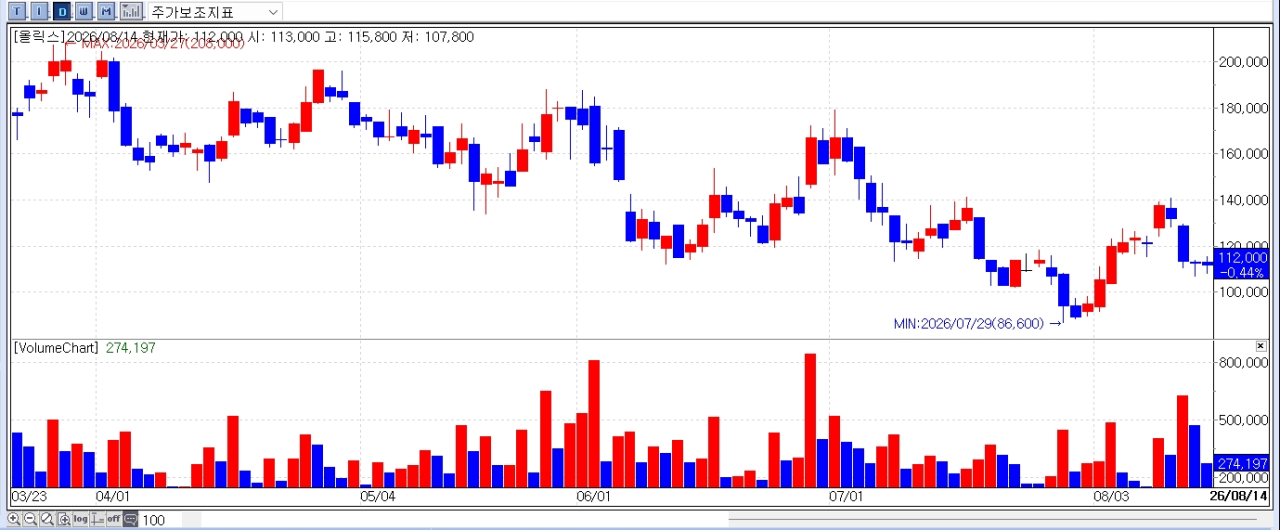
OliX down 18.7% in four days on CPS concerns
OliX Pharmaceuticals has come under sharp selling pressure in recent sessions as concerns mount over a potential CPS overhang. The company has sought to reassure investors by stressing that existing CPS holders remain focused on its medium- to long-term growth prospects rather than short-term exits, but the message has so far fallen short of fully easing supply-demand concerns.
OliX shares fell as low as 107,900 won during the Aug. 14 session, down 4.09% from the previous close, before paring losses to finish at 112,000 won, down 500 won, or 0.44%. The company issued a statement at 1:25 p.m. seeking to address concerns over the potential CPS overhang.
Viewed over a longer period, however, the stock has fallen for four consecutive sessions. OliX closed at 137,800 won on Aug. 10, meaning it has lost 18.7% in just four trading days. On Aug. 12 alone, the stock plunged 14% to 113,500 won.
The main factor weighing on the shares is the approaching date when a large batch of CPS issued last year becomes eligible for conversion into common shares.
In August last year, OliX issued 1,979,347 CPS worth 115 billion won to domestic and overseas institutional investors. The shares were issued at a conversion price of 58,101 won per share and were subject to a one-year lock-up. They become eligible for conversion from Aug. 29, with actual conversion requests expected to begin on Aug. 31, the first business day thereafter.
OliX’s closing price of 112,000 won on Aug. 14 was about 93% above the conversion price. With CPS investors sitting on substantial unrealized gains, the possibility that some could seek to realize profits has emerged as a source of potential selling pressure.
OliX’s decision to issue a statement highlighting the long-term investment stance of existing investors appears to have been aimed in large part at addressing such concerns.
The company emphasized that many CPS investors — including KB Investment, AJU IB Investment, Kiwoom Investment and IMM Investment — had previously invested in OliX. It also cited Kook Chan-woo, chief investment officer of KB Investment, as saying that the firm was more focused on the value OliX could create over the medium to long term through expanded global partnerships and platform development than on the timing of a short-term exit.
OliX also pointed to Weiss Asset Management, a U.S.-based investment firm that participated in last year’s CPS financing and followed up with an investment of about 100 billion won in common shares in June, as evidence of continued long-term confidence in the company.
Still, investors’ positive views on OliX’s medium- to long-term growth prospects are separate from whether they will convert their CPS or sell the resulting common shares. Even an institution with a favorable long-term view of a company may choose to recover part of its investment depending on fund maturities, exit schedules or portfolio risk management.
OliX is also understood not to have secured additional lock-up commitments or agreements restricting share sales from the CPS investors. While it is unlikely that all 1.98 million shares will immediately hit the market once conversion becomes possible later this month, the potential supply remains an overhang as long as those shares can eventually become tradable.
Industry observers likewise say investors should distinguish between confidence in OliX’s long-term growth and the actual exit strategies of individual CPS holders.
“It is difficult to determine whether CPS investors will sell their shares based solely on the company’s explanation,” a biotech industry official said. “Even investors who remain optimistic about the company’s long-term growth may sell part of their holdings for risk-management purposes.”


![삼전닉스보다 더 뜨겁다…마이크론 깜짝 실적에 뜨는 소부장[종목e슈]](https://image.edaily.co.kr/images/vision/files/NP/S/2026/10/PS26100300289t.jpg)
!["역에서 나오자마자 집?"…서울 7억대 아파트 3곳 가보니[랜선임장]](https://image.edaily.co.kr/images/vision/files/NP/S/2026/10/PS26100300386t.jpg)

![집 팔았는데 돈도 사람도 그대로…'2분 13초'의 비밀[세금, 그 후]](https://image.edaily.co.kr/images/vision/files/NP/S/2026/10/PS26100300011t.jpg)
![[그해 오늘] 27살 출소? 40대 성폭행 뒤 웃은 중학생, 감옥서 '엽기 범죄'](https://image.edaily.co.kr/images/vision/files/NP/S/2026/10/PS26100300003t.jpg)