



This article was released as Pharm Edaily Premium Content on September 6, 2026, at 7:50 AM.
[Yu Jin-hee, Edaily Reporter] As the domestic stock market re-aligns around solid corporate performance, clinical developments, and tangible commercialization milestones, the biotech sector on September 4 witnessed strong capital inflows targeting companies with proven technologies and growth momentum. Moving away from speculative rallies driven by pure market sentiment, competent players armed with global regulatory clearances, proprietary supply ecosystems, and distinctive platform technologies ranked among the top market gainers, asserting their roles as leading market drivers.
|

Skylabs Surges 135% on Kosdaq Debut: ‘World’s Only Ring-Type Blood Pressure Monitor’
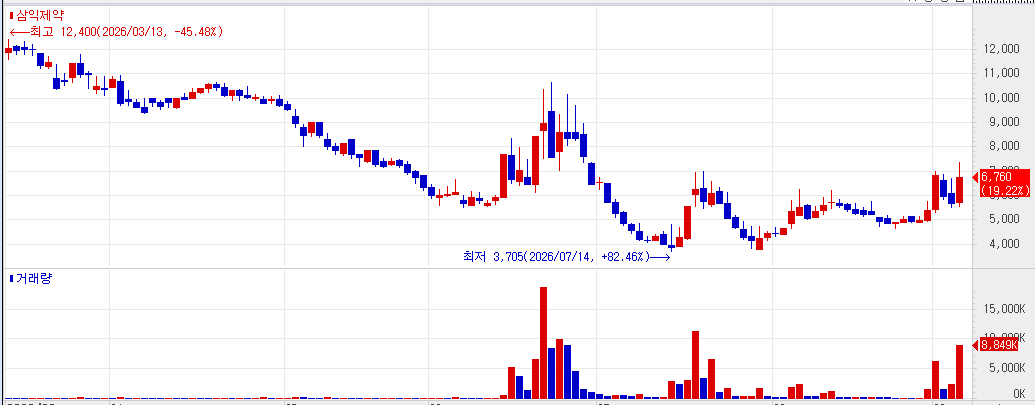
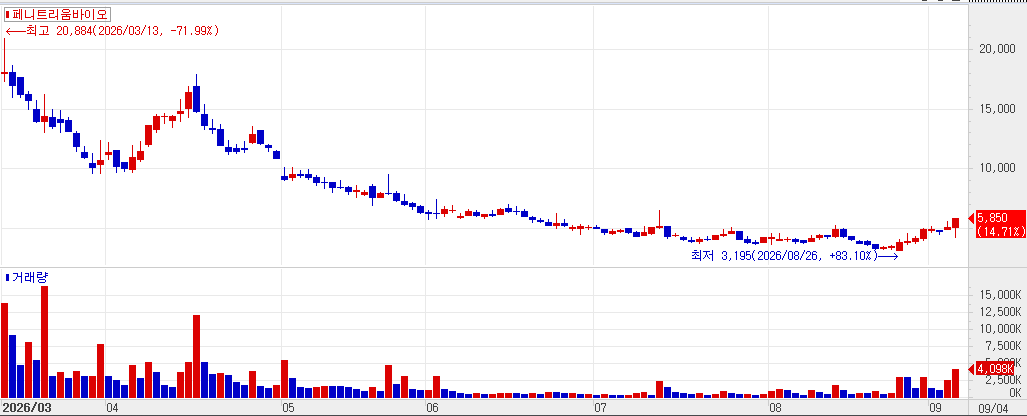
According to KG Zeroin’s market analysis platform MP Doctor, the top-performing biotech trio listed among the broader domestic stock market's ‘Top 20 Gainers’ on this day comprised Skylabs, Samik Pharma, and Penetrium Bio. The share price of Skylabs surged 135.00% from the previous session to close at 23,500 KRW, while Samik Pharma jumped 19.22% to 6,760 KRW and Penetrium Bio advanced 14.71% to 5,850 KRW, drawing substantial institutional and retail interest.
Market observers noted that companies validating their business models with certifications from prominent global regulatory bodies and establishing reliable cash cows continue to secure premium valuations amid ongoing volatility. Skylabs, which spiked 135.00% above its offering price on its Kosdaq debut, saw its rally fueled by the commercialization of the world’s only medical-grade ring-type cuffless blood pressure monitor coupled with steep revenue growth.
Positioning itself beyond a conventional hardware manufacturer, Skylabs operates an artificial intelligence (AI)-powered healthcare data production platform that generates clinical-grade vital signs by integrating its proprietary hardware with predictive algorithms. Its flagship product, ‘CART BP pro,’ is a ring-type medical device engineered to monitor blood pressure fluctuations 24/7 without disturbing a patient’s daily routine or sleep. As of the first half of the year, it was deployed across more than 2,000 domestic hospitals and clinics, including South Korea's premier "Big 5" tertiary medical institutions: Seoul National University Hospital, Asan Medical Center, Samsung Medical Center, Severance Hospital, and Seoul St. Mary’s Hospital.
Over the past year following the domestic launch of CART BP pro, total national prescriptions for 24-hour ambulatory blood pressure monitoring (E6547) surged 52.7% compared to the pre-launch baseline. CART BP pro accounted for 52.4% of this total volume, demonstrating its capacity not only to substitute legacy devices but also to expand overall clinical diagnostic demand.
The company's competitive moat remains technically formidable. Deriving accurate continuous blood pressure readings by processing photoplethysmography (PPG) optical signals through advanced AI algorithms represents one of the most demanding engineering challenges in wearable medicine. After obtaining both medical device marketing approval and national health insurance reimbursement from the Ministry of Food and Drug Safety (MFDS), the device was officially included in the Korean Society of Hypertension's ‘2026 Hypertension Practice Guidelines’ as an accredited out-of-office diagnostic instrument.
This technical foundation is complemented by scalable commercial partnerships. The company delivers business-to-business (B2B) supply through Daewoong Pharmaceutical’s nationwide clinical distribution network, alongside system integration with Seers Technology’s AI smart inpatient monitoring platform, ‘thynC’. Driven by these synergies, revenue has doubled annually, reaching 7.9 billion KRW last year, with international sales contributing 52% of total top-line revenue in the first half of this year. Skylabs has secured the European Medical Device Regulation (CE-MDR) certification, executed a key European distribution agreement with German ABPM specialist IEM, partnered with Omron Healthcare and Otsuka Pharmaceutical in Japan, and initiated approval processes with the U.S. Food and Drug Administration (FDA).
Lee Byung-hwan, Chief Executive Officer of Skylabs, said: “Our listing on the Kosdaq market will accelerate our expansion across global blood pressure monitoring sectors. By leveraging proprietary biometric big data, we will establish Skylabs as a global medical data production platform spanning pharmaceutical clinical trials and AI-assisted diagnostics.”
|
Samik Pharma Secures Patent for ‘Dimpled Microspheres’: Entering Regenerative Medicine Fillers
Samik Pharma, which climbed 19.22% to secure a spot among the day’s top gainers, derived strong market momentum from expanding its proprietary drug delivery platform into high-margin regenerative tissue-repair medical devices. On the same day, Samik Pharma announced it had finalized the domestic patent registration (No. 10-3007858) for its proprietary ‘Dimpled Biodegradable Polymer Microspheres and Manufacturing Method Thereof.’
The patented technology involves precision-engineering micro-indentations—resembling the surface dimples of a golf ball—onto the exterior of biodegradable microspheres that dissolve progressively within the human body.
The company’s research team focused on modulating surface contact properties to trigger enhanced cellular responses from fibroblasts, the cells responsible for natural collagen synthesis in skin tissues. In comparative in vitro human dermal fibroblast assays, standard spherical microspheres generated approximately 105% collagen production relative to an untreated control (100%), whereas the dimpled microspheres produced between 110% and 121%, representing up to a 21% relative increase in collagen synthesis.
This process leverages the micro-particle precision engineering expertise cultivated through Samik Pharma’s proprietary extended-release injectable platform, ‘UniSphero’. By employing limonene as an inducer for dimple generation and applying microporous membrane controls, the company achieved uniform particle size distributions (average D50: 43–71 µm; span: 0.8–1.1). The method provides broad chemical versatility, adaptable to widely utilized biodegradable polymers such as PLLA, PLGA, and PCL.
Capitalizing on this intellectual property milestone, Samik Pharma plans to expand its operational footprint from conventional drug delivery carriers into medical aesthetic consumables and tissue-restoration fillers. The company recently amended its corporate articles of incorporation to formally add the manufacturing and distribution of medical devices to its business scope, initiating preclinical evaluations and regulatory quality certifications.
An official at Samik Pharma stated: “Our dimpled microspheres establish a distinctive surface modification architecture, confirming clear potential as regenerative tissue scaffolds through rigorous cellular assays. Built on the UniSphero platform, we will systematically develop high-functionality medical devices, including dermal fillers, establishing them as principal growth drivers for the company.”
|
Overturning an 80-Year Cancer Paradigm: Penetrium Bio Advances on U.S. FDA Phase 2a Approval
Penetrium Bio advanced 14.71%, sustaining its upward trajectory after securing formal U.S. regulatory clearance for an oncological therapeutic designed to reverse tumor microenvironment barriers in refractory solid tumor indications. The company announced it received Investigational New Drug (IND) clearance from the U.S. FDA for a multi-center Phase 2a clinical trial evaluating ‘Penetrium’, a first-in-class oncology candidate designed to overcome therapeutic pseudo-resistance in patients with advanced solid tumors.
The multi-center U.S. trial is designed to evaluate the safety and anti-tumor efficacy of combining Penetrium with standard-of-care (SoC) chemotherapy or targeted agents in patients who have developed resistance or failed to respond to initial therapies.
The clearance has drawn international clinical attention because it addresses the underlying mechanism of therapeutic resistance that has challenged conventional oncology for over eight decades. Historically, therapeutic failure upon repeated dosing was predominantly attributed to direct tumor cell mutations, categorized as "true resistance." Consequently, clinical protocols routinely relied on dose escalations or transitions to higher-toxicity alternative chemotherapies, which frequently exacerbated systemic toxicity without improving survival outcomes.
Penetrium Bio’s research focuses on the finding that a substantial portion of treatment failures stems not from genetic mutations, but from physical drug delivery failure caused by stromal tumor barriers—a phenomenon defined as ‘pseudo-resistance.’
Upon standard chemotherapeutic exposure, cancer-associated fibroblasts (CAFs) and tumor-associated macrophages (TAMs) frequently become hyperactivated within the tumor microenvironment. This triggers excessive extracellular matrix (ECM) stiffening and elevated interstitial fluid pressure (IFP), creating a dense physical barrier. Standard anticancer agents are blocked by this barrier, reaching deep tumor tissues only at sub-lethal concentrations, rendering them clinically ineffective despite theoretical potency.
Penetrium reversibly modulates the tumor microenvironment by concurrently targeting and downregulating hyperactivated CAFs and TAMs. This mode of action softens the fibrotic ECM and normalizes elevated intratumoral fluid pressure, re-establishing physical transport conduits so that co-administered standard therapies can penetrate the tumor core at designed lethal doses.
The U.S. FDA’s approval of a clinical protocol that re-administers previously failed standard-of-care drugs in combination with Penetrium provides regulatory validation for the scientific concept of "therapeutic resensitization." Because metastatic lesions share the same stromal barrier characteristics as primary tumors, this therapeutic mechanism offers the potential to target both simultaneously. Furthermore, backed by existing human safety and pharmacokinetic (PK) datasets, the company has established a modular platform approach that allows pipeline candidates entering new solid tumor indications to advance straight into Phase 2 clinical trials without repeating Phase 1 safety evaluations.
Cho Won-dong, Chairman of Penetrium Bio, stated: “This U.S. FDA IND clearance marks the entrance of a stromal barrier-modulating therapy onto the global clinical stage, shifting beyond the historical convention that misattributed drug delivery failure solely to cellular mutations. Through rigorous multi-center trials in partnership with leading U.S. cancer research centers, we aim to validate objective clinical efficacy and deliver a pragmatic therapeutic alternative to oncology patients worldwide.”



![주식은 홀짝 도박 아니다...폭락장 속 ‘AI 반격의 조건' [어쨌든 경제]](https://image.edaily.co.kr/images/vision/files/NP/S/2026/10/PS26102600473t.jpg)